Home / betting-resources / Legendary Ethiopian Runners and Their Historic Achievements

Legendary Ethiopian Runners and Their Historic Achievements

Published 07 May 2026
Legendary Ethiopian Runners and Their Historic Achievements
Ethiopia has earned a unique place in the world of athletics, especially in long-distance running. The country’s rugged highlands, often located more than 2,000 meters above sea level, have produced generations of elite athletes with extraordinary endurance. The history of athletics in Eethiopia is not just about competitions and medals. It reflects a deep cultural connection to running, where many children grow up covering long distances daily, often running to school or helping families in rural areas. Over time, this natural foundation evolved into a structured athletic tradition that brought global recognition. Today, the global fascination with Ethiopian runners extends far beyond the track. Fans follow their performances closely, and even related industries have grown in popularity, including digital platforms such as Ethiopian betting sites, which highlight the increasing worldwide interest in athletics. This growing attention is driven by the remarkable consistency and dominance Ethiopian athletes have shown in major competitions.

The Rise of Ethiopian Running Legends

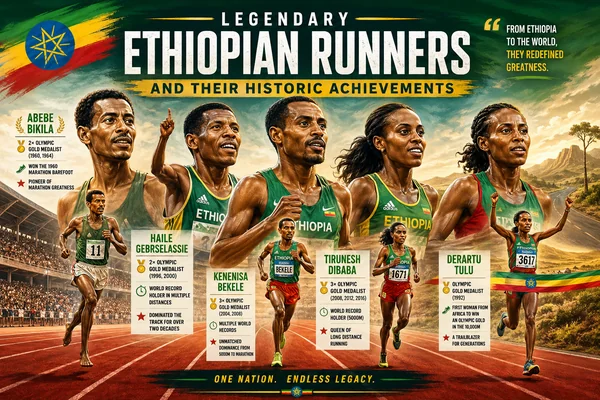
When discussing famous Ethiopian runners, one cannot ignore the pioneers who transformed the sport. These athletes not only won medals but also changed how the world perceived African distance running. Their achievements created a pathway for future generations and helped establish Ethiopia as a global powerhouse. Among these trailblazers, Derartu Tulu stands as a historic figure. Born in the village of Bekoji, she made global headlines at the 1992 Barcelona Olympics by winning gold in the 10,000 meters. She became the first Ethiopian woman and the first Black African woman to achieve this milestone . Her victory carried immense symbolic importance, breaking barriers and inspiring women across Africa. Tulu later confirmed her greatness by winning another Olympic gold medal in Sydney in 2000 and adding a bronze in Athens in 2004 . Her career also included success in cross-country championships and major marathons, including a memorable win at the New York City Marathon in 2009 at the age of 37 .

A Dynasty of Excellence

Derartu Tulu’s influence extended beyond her own achievements. She became a role model for a new generation of runners, including her relatives. One of the most celebrated athletes to follow her path is Tirunesh Dibaba, often considered one of the greatest female distance runners in history. Born in 1985 in the same region of Arsi, Dibaba quickly demonstrated exceptional talent. She became the youngest world champion at just 18 years old and later achieved an extraordinary record: three Olympic gold medals and five World Championship titles . Her dominance in both the 5,000 and 10,000 meters was unmatched for years. At the 2008 Beijing Olympics, she achieved a rare double victory, winning both events. Her personal best time of 14:11.15 in the 5,000 meters once stood as a world record and remains among the fastest performances ever recorded . Dibaba’s racing style combined patience and explosive speed. She was known for staying within the pack before delivering a powerful finishing kick that left competitors unable to respond. This tactical intelligence made her one of the most feared athletes on the track.

Rivalry and Record-Breaking Performances

Another key figure in Ethiopia’s running legacy is Meseret Defar, whose career added depth and excitement to the sport. Defar specialized in the 3,000 and 5,000 meters and became a two-time Olympic champion in the 5,000 meters, winning gold in Athens 2004 and London 2012 . She also set world records in the 5,000 meters in 2006 and 2007, holding the title until it was later broken by Dibaba. One of Defar’s most remarkable achievements came in 2007, when she ran the two-mile distance in 8:58.58, becoming the first woman in history to break the nine-minute barrier . Her rivalry with Dibaba created one of the most competitive eras in women’s distance running, pushing both athletes to reach new heights. This period of intense competition not only elevated their individual performances but also strengthened Ethiopia’s reputation as a leader in athletics.

The Strength of Ethiopian Long-Distance Running

The dominance of Ethiopian long-distance runners is not a coincidence. Several factors contribute to their success. First, altitude plays a crucial role. Training in high-altitude environments forces the body to adapt by improving oxygen efficiency, which provides a significant advantage in endurance events. Second, the culture of running in Ethiopia encourages early participation. Many athletes begin running as children, building natural stamina and discipline. Local competitions are highly competitive, ensuring that only the strongest athletes rise to the national and international levels. Third, Ethiopia has developed a network of training camps and experienced coaches who combine traditional methods with modern sports science. This balance allows athletes to maintain their natural strengths while benefiting from advanced techniques.

Beyond Medals: Cultural and Global Impact

The achievements of Ethiopian runners extend far beyond medals and records. They have become symbols of national pride and global inspiration. Stories of athletes rising from rural villages to Olympic podiums resonate with people around the world. Derartu Tulu’s victory in 1992, for example, was more than a sporting success. It marked a moment of unity and progress, inspiring countless young athletes to pursue their dreams. Similarly, Tirunesh Dibaba’s consistent dominance showed that excellence could be sustained over many years with discipline and determination. These athletes have also contributed to the global popularity of distance running. Their performances have drawn attention to major international events and inspired new generations of runners worldwide.

The Legacy Continues

Ethiopia continues to produce exceptional talent, building on the legacy established by its legends. Young athletes follow in the footsteps of Tulu, Dibaba, and Defar, aiming to achieve greatness on the global stage. The country remains a dominant force in international competitions, consistently winning medals in Olympic and World Championship events. What sets Ethiopian runners apart is not just their physical ability but their mindset. They combine resilience, discipline, and a deep cultural connection to running. This unique combination ensures that Ethiopia will remain at the forefront of distance running for years to come.

Conclusion

The story of Ethiopian runners is one of perseverance, talent, and inspiration. From groundbreaking pioneers like Derartu Tulu to dominant champions like Tirunesh Dibaba and record-breaking athletes like Meseret Defar, Ethiopia has produced some of the greatest runners in history. Their achievements have transformed athletics and inspired millions worldwide. As new athletes emerge and records continue to fall, the legacy of Ethiopian running remains as strong as ever. It is a story that continues to evolve, driven by passion, tradition, and an unwavering pursuit of excellence.