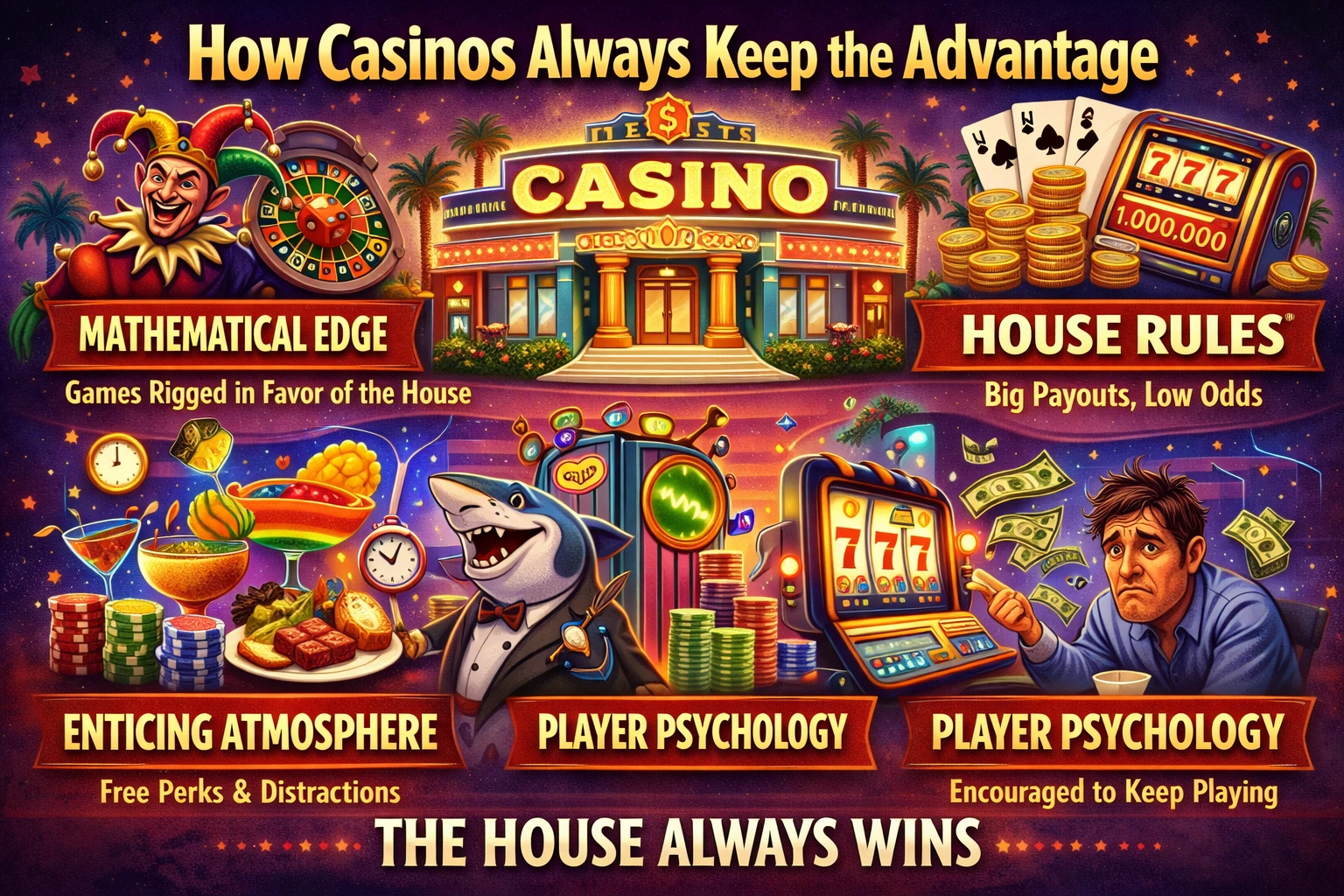
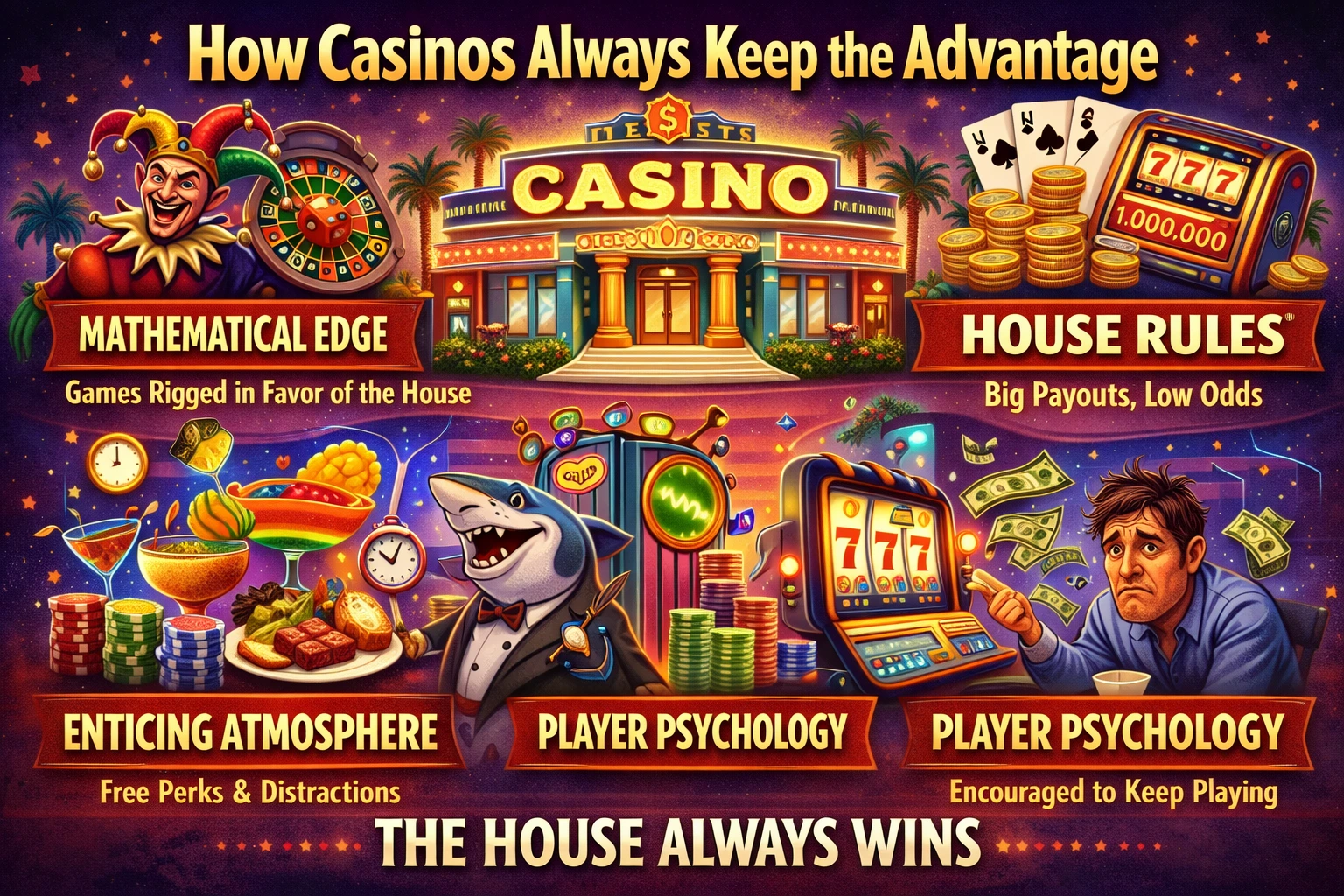
 Understanding how this advantage is created explains why casinos remain profitable across markets, platforms, and decades — regardless of trends or player strategies.
The Mathematical Core: House Edge
Every casino game includes a built-in house edge. This is not a trick or hidden fee; it is a mathematical property of the game itself. The house edge defines how much of each wager the casino expects to keep over a large number of bets.| Game Type | Average House Edge |
| Slots | 3%–10% |
| European Roulette | ~2.7% |
| Blackjack (basic strategy) | ~0.5%–1% |
| Live casino tables | 1%–3% |
Why Volume Matters More Than Outcomes
Casinos operate on volume, not prediction. Thousands of players placing millions of bets create statistical certainty. This advantage is reinforced by:- High bet frequency through fast game cycles
- Long session times encouraged by platform design
- A wide range of games covering different risk preferences
Bonuses Don’t Remove the Edge — They Redirect Play
Bonuses are often misunderstood as generosity. In practice, they are precision tools used to guide player behavior while protecting margins. Around the midpoint of the player lifecycle, offers such as the Lemon Casino bonus are introduced to increase engagement without altering the core mathematics. Bonuses work because:- Wagering requirements convert bonuses into turnover
- Game restrictions steer play toward higher-margin products
- Time limits accelerate betting behavior
Game Design Reinforces the Advantage
Modern casino games are carefully engineered experiences, not simple random events. Volatility, payout timing, and reward frequency are all adjustable parameters.| Design Element | Effect on Casino Advantage |
| Volatility settings | Control win distribution |
| Near-miss mechanics | Encourage continued play |
| Bonus rounds | Increase engagement without raising RTP |
| Fast spin speeds | Increase bets per session |
Psychology Works in the Casino’s Favor
Casinos benefit from predictable human behavior. Players tend to react emotionally to short-term outcomes, while the casino relies on long-term averages. Common patterns include:- Chasing losses after near wins
- Overestimating personal skill in chance-based games
- Misjudging probabilities based on recent results
Data, Segmentation, and Control
Behind the interface, casinos operate as data-driven platforms. Player behavior is tracked, segmented, and analyzed continuously. This allows operators to:- Personalize limits and promotions
- Detect abnormal or risky betting patterns
- Protect margins by adjusting exposure